Last updated November 25, 2026
How to Hire an ADU Contractor in Folsom: A Step-by-Step Guide
The most dangerous ADU contractor in Folsom isn’t the unlicensed one working out of a pickup. It’s the fully licensed general contractor who outsources design to a draftsperson three cities away, has never sat in a Folsom plan-check meeting, and will learn your project’s permit requirements at the very same moment you do. The license looks fine. The portfolio looks fine. And then the correction letters start arriving, the revisions get billed back to you, and a project you budgeted for one number drifts toward another. This guide shows you how to tell a real ADU specialist from a generalist in ADU clothing, using the questions, records, and contract language that actually separate them.
Quick Answer
To hire an ADU contractor in Folsom, verify their actual ADU permit history through the city’s public permit portal, not their website gallery. Then ask five questions only a genuine ADU specialist can answer: plan-check turnaround experience, correction letter handling, utility coordination, local setback familiarity, and their standing subcontractor roster. Finally, read the contract for allowance language, revision rounds, and change-order terms that address permit delays. A specialist’s slightly higher bid often lands at a lower total project cost because it already accounts for the permit iterations a generalist’s low bid quietly excludes.
Table of Contents
- Why hiring an ADU contractor is different from hiring for a remodel
- The five questions a generalist cannot answer confidently
- How to verify a contractor’s real Folsom ADU permit history
- What in-house design and permit handling actually means
- Contract red flags: allowances, revisions, and change orders
- Site-built vs. prefab: which path fits your Folsom lot
- Why the higher bid often costs less in the end
- The ten-step hiring process, start to finish
Why Hiring an ADU Contractor in Folsom Is Different From Hiring for a Remodel
A kitchen remodel happens inside a building that already exists, already has utilities, already passed its original inspection, and sits within a footprint the city has long since approved. An ADU creates a new dwelling unit on your lot. That means a new address, new utility connections, new zoning review, new setbacks to verify, and a planning department that treats the project as a small development rather than a renovation. The skill set is different. A contractor who has built forty kitchens may have built zero ADUs.
That gap matters more in Folsom than in many places because the lots vary enormously. A parcel in a canyon-adjacent neighborhood off Green Valley Road can have slope and drainage questions that a flat lot in the older grid near Sutter Street never raises. A home in the Empire Ranch area may have HOA design review layered on top of city review. We’ve seen homeowners assume their neighbor’s approved ADU sets a template, only to find that the neighbor’s lot sat two feet differently against a property line. The rules depend on the city and the specific lot, which is why we confirm every constraint with Folsom’s planning or building department before plans are final.
Here’s the practical consequence. When you interview a contractor, you’re not judging general construction competence. You’re judging whether they’ve walked this specific permit pathway before, with this city, on lots that resemble yours. That’s a narrower skill than “good builder,” and it’s the one to screen for.
The Five Questions a Generalist Cannot Answer Confidently
Ask these in your first conversation. You’re not looking for a rehearsed pitch. You’re listening for the texture of someone who has actually done the work. A specialist answers from memory. A generalist stalls, generalizes, or promises to “find out and get back to you.”
- What plan-check turnaround are you seeing right now in Folsom? Not “a few weeks” – ask what they’re actually experiencing on current submittals, and whether it has shifted recently. Anyone actively building ADUs in Folsom knows the current rhythm.
- Can you give me two or three real examples of correction letters you’ve received and how you resolved them? Every ADU goes through at least one revision round. A contractor who claims a clean first pass every time is either new or not being straight with you.
- How do you handle coordination with the utility on new service connections? Folsom’s electric utility coordination on new service is its own process. Ask specifically who communicates with the utility, when it happens in the schedule, and what the contractor’s role is versus yours.
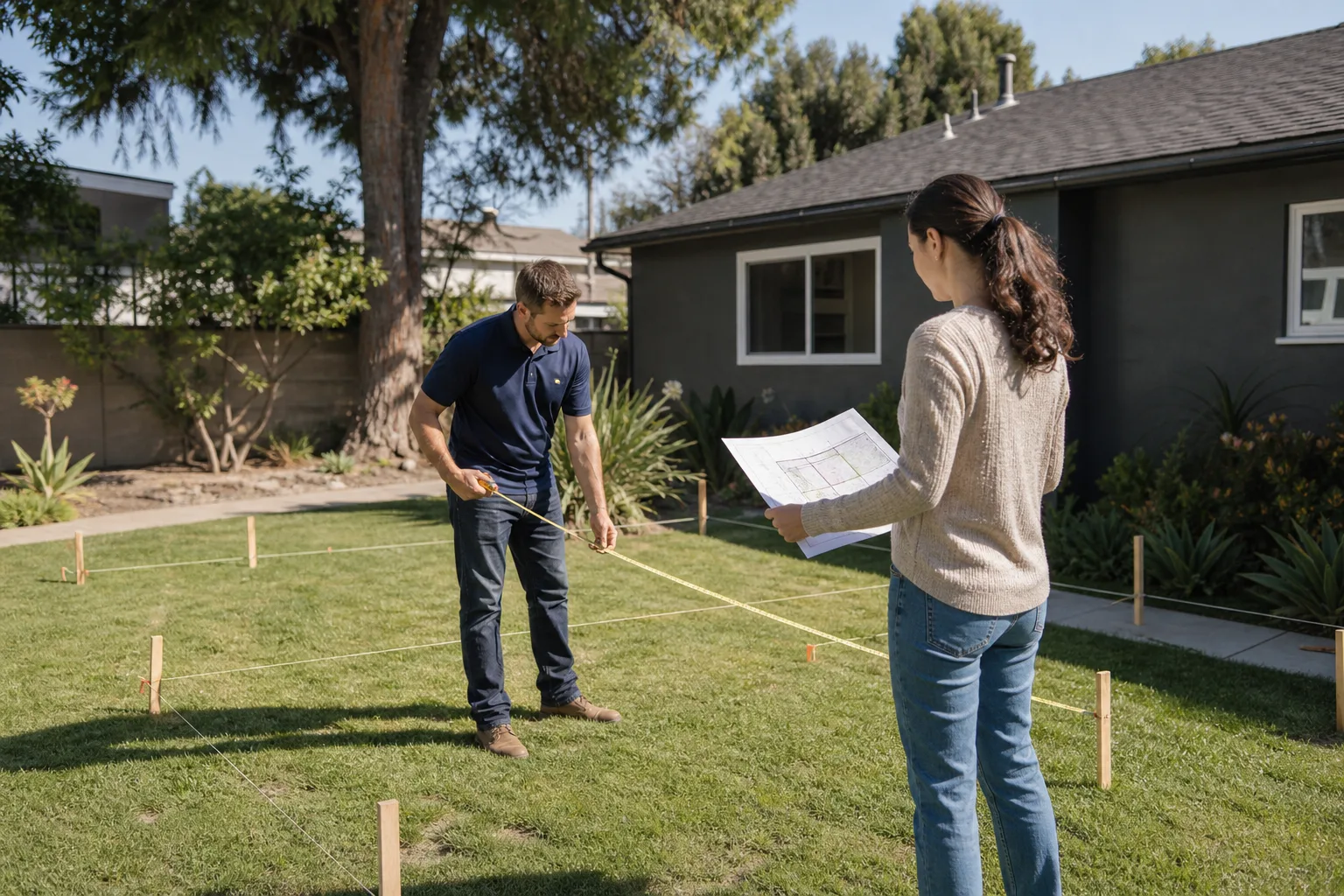
- What setback requirements actually apply to my lot, and how did you determine them? There’s no single answer that applies across Folsom. What you want to hear is a process: they pull the parcel data, check zoning, consider existing structures on the lot, and confirm with the city before design is fixed.
- Which subcontractors do you use on every ADU you build, and are they ADU-specific? Names and roles. A specialist has a stable roster tuned to ADU work – foundations, framing, utilities, finishing – not a rotating bench of whoever’s available.
Pay attention to how the answers land. Consistent, specific, unprompted detail is the signal. Vague reassurance is the warning.
How to Verify a Contractor’s Real Folsom ADU Permit History
Every permit pulled in Folsom is a matter of public record. You can look up a contractor’s permit history through the city’s online permit portal – sometimes called an online permitting system or citizen access portal – and see what they’ve actually built versus what they advertise. This is the single most useful fifteen minutes you’ll spend in the hiring process.
Here’s how to work it:
- Ask the contractor for their name as it appears on their license or business permit – not their marketing name. Portals search by the applicant or contractor on record.
- Search the portal for ADU-related permits – accessory dwelling unit, second dwelling unit, garage conversion, junior ADU.
- Note the addresses and permit status. Look for completed permits, not just issued ones. A permit that’s been open for a very long time is worth asking about.
- Count how many are actually in Folsom. A contractor can be busy across the region and still have very few local ADU permits.
- Ask them to walk you through one or two of those permits – what the original submission included, what got flagged, how they resolved it.
What you’re avoiding here is the licensed general contractor whose portfolio features one ADU and whose website features twelve. If their permit record shows a handful of remodels and a single ADU, that tells you what you need to know. Consider also asking about their work in neighboring jurisdictions, since ADU experience elsewhere often transfers – and if you’re comparing against builders outside Folsom, the ADU builders serving this area is the right place to see how our process compares.
What In-House Design and Permit Handling Actually Means
Two contractors can both say “we handle permits.” Those statements can mean wildly different things. The distinction is whether design, drafting, permit submission, and permit response all live inside one accountable process, or get spread across a designer, an engineer, a permit expediter, and the contractor, each of whom can fairly say “not my part” when a correction letter lands.
When a contractor “coordinates with a third-party designer,” here’s what typically happens. You hire the contractor. The contractor sends your project to a designer they work with sometimes. The designer produces plans. The contractor submits. The city returns corrections. The designer revises, sometimes at an additional fee, sometimes slowly, and the contractor isn’t positioned to absorb that cost or drive the timeline. You are. That’s the practical difference between coordination and ownership.
In-house design and permit handling means one party answers for the whole pathway – zoning checks, setbacks, utility connections, plan submission, correction response, and final inspection – from permit application to move-in day. That’s the model we build around at ADU Builder Folsom, and it’s why the correction rounds that derail projects elsewhere usually don’t surprise the schedule here.
Ask the question directly: “If the city sends corrections, who revises the plans, who pays for the revision, and how many rounds are included?” If the answer includes “well, that depends on the designer,” you’ve found the gap.
Contract Red Flags: Allowances, Revisions, and Change Orders
An ADU contract is where the real risk lives, not in the sales conversation. The three areas that most often produce surprises are allowance budgets, revision rounds, and permit-delay language. Read for them.
Vague allowance budgets. An allowance is a placeholder number the contractor puts in the contract for a category of work – finishes, fixtures, site work – to be finalized later. That’s not automatically bad, but an allowance with no basis is. Ask what the allowance covers, what the expected cost basis is, and what happens if actual costs exceed it. A number below what you’ll reasonably spend is a way to make a bid look lower than it is. Folsom-specific site work – drainage on a sloping lot, utility trenching, grading – is a common place where allowances quietly blow up.
No mention of plan-check revision rounds. Most ADU projects receive at least one correction letter. The contract should say how many revision rounds are included before extra fees kick in. If revisions aren’t specified, assume they’ll be billed to you.
Change-order language that doesn’t address permit delays. Change orders handle scope changes. They don’t naturally cover permit-related delays, plan-check backlogs, or city-requested design changes. If your contract has no language for how permit delays affect schedule and cost, you’re exposed.
A few more red flags to check:
- No mention of permit fees in the budget, or permit fees “TBD” – ask who pays them and how much they’re likely to be.
- A schedule with no permit-reviewed milestone marked on it.
- A contract that names a start date without naming a permit-issuance trigger.
- No written description of who attends plan-check meetings – them, their designer, you?
Site-Built vs. Prefab: Which Path Fits Your Folsom Lot
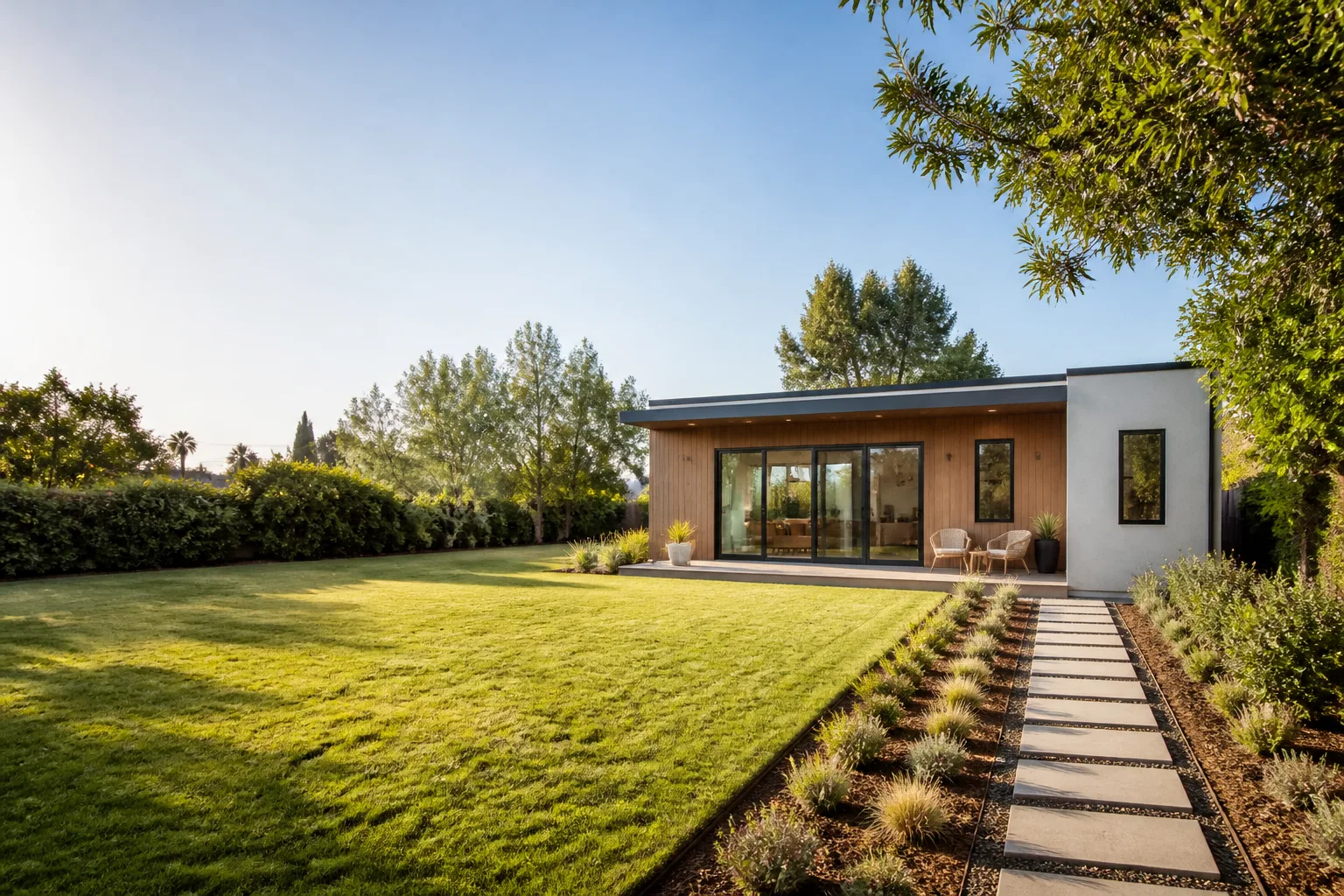
A dedicated ADU contractor should offer both paths and help you choose, because the right answer depends on the lot, the budget, and the timeline, not on what the contractor prefers to build. Site-built construction gives you maximum design freedom, which matters when your lot is irregular, has grade change, or sits in a neighborhood with specific architectural character worth matching. Prefab units arrive engineered in a factory, which can deliver faster assembly and more predictable quality control, provided your lot can accommodate delivery and placement.
We’re authorized to build and install ADUs from three nationally recognized prefab brands – Abodu, Cover, and Dvele – alongside traditional site-built construction. That means the conversation isn’t “which is better” but “which is right for this lot.” A flat, accessible parcel with clear delivery access and a straightforward design brief can be a strong prefab fit. A lot with tricky access, significant grade change, or a design brief that needs to match a specific existing home often points to site-built. A garage conversion is a third path entirely – the structure exists, the foundation is there, and the work becomes reimagining an existing enclosure into a living unit.
Ask any contractor you interview whether they offer both. A contractor who only builds site-built will argue site-built is always better. A contractor who only installs prefab will argue the reverse. The right answer depends on your parcel in Folsom, and a specialist should be comfortable explaining which way the logic points and why.
Why the Higher Bid Often Costs Less in the End
When you line up two bids side by side, the lower number feels safer. In ADU work, it often isn’t. The reason is that a general contractor’s lower bid frequently excludes work the project will need – permit iterations, plan-check revisions, utility coordination, sometimes site work contingent on a soils report – because those are activities they haven’t fully factored in. A dedicated ADU specialist builds those into the bid because they know from experience they’ll happen. The specialist’s bid is higher because it’s more complete, not because they’re more expensive.
Here’s what a comparison looks like when you add the missing pieces:
- Base construction: often similar.
- Plan-check revision rounds: usually inside a specialist’s bid, usually billed extra by a generalist.
- Permit coordination and materials: usually included by a specialist, sometimes vague or omitted by a generalist.
- Design coordination between designer and contractor: included in a specialist’s scope, negotiated separately in a generalist’s arrangement.
- Schedule exposure from correction backlogs: actively managed by a specialist, passively suffered by a generalist.
The point isn’t that every specialist bid wins on total cost. Some general contractors are excellent and price accurately. The point is that a bid comparison is only meaningful when you’ve verified both bids cover the same scope. Ask both contractors to itemize permit-related work explicitly. The numbers tend to converge once the scope is aligned, and the difference that remains is usually the cost of a smoother process.
The Ten-Step Hiring Process, Start to Finish
Here’s the sequence we recommend to every homeowner considering an ADU in Folsom. It’s not a quick process – it’s a six-figure decision, and it deserves the time – but each step moves you decisively closer to the right contractor.
- Define the use case. Rental income, family housing, aging-in-place – each shapes the design and the type of ADU that fits. Decide before you talk to builders, so the conversation starts pointed.
- Check your lot’s basic constraints. Zoning, existing structures, and access all shape what’s feasible. A specialist will check these for you, but understanding them yourself makes you a better client.
- Interview at least three contractors. Ask the five questions above. Take notes. Compare answers not just for accuracy but for comfort and specificity.
- Verify permits in the city portal. For each contractor, look up their ADU permit history in Folsom. This is the step most homeowners skip and the one that most reliably separates specialists from generalists.
- Request written, itemized estimates. Not a lump-sum quote. Itemized means you can see how allowances are built, what permit-related work is included, and what the revision policy is. The estimate is free, and the written estimate is what sets the final price.
- Compare bids line by line. Line up both bids next to each other and confirm they cover the same scope. If one is significantly lower, ask what’s excluded.
- Read the contract carefully. Allowances, revisions, permit delays, change-order language. Ask for clarification in writing on anything that reads vaguely.
- Confirm who handles permits. If the contractor’s internal team handles design and permit submission, that’s the ideal. If they coordinate with a third party, understand who’s accountable for corrections.
- Confirm who attends plan-check. You want the contractor, or their in-house design team, present and accountable in the process, not outsourced.
- Sign with a clear final scope. The written estimate sets the price, the contract locks the scope, and the schedule runs from permit issuance.
Pathways like a garage conversion run through much of this process, though the design and permit questions differ from a new freestanding unit, and a junior ADU has its own parameters again. Any contractor you hire should be able to explain which pathway fits your goal and your lot, and why.
Common Mistakes to Avoid
- Hiring the first contractor who returns your call. In an ADU project, responsiveness in the sales phase tells you nothing about permit-phase competence. Interview several. Compare answers to the five questions.
- Trusting the portfolio over the permit record. Websites showcase finished photos. The permit portal shows what a contractor has actually built and where. Check both. When they disagree, the portal is right.
- Accepting vague allowance language. Allowances that aren’t tied to a cost basis are the most common way a bid goes up after signing. Insist on clarity. Folsom lots with slope or drainage complexity make this especially important.
- Assuming the contractor will handle plan-check. “We handle permits” and “we handle plan-check revisions ourselves” aren’t the same statement. Confirm who attends and who revises.
- Comparing bids without scope alignment. A low bid that excludes permit iterations isn’t a low bid. It’s a partial bid. Itemize both before you compare totals.
- Overlooking utility coordination. Folsom’s electric utility coordination is a real step in the schedule. Ask about it. Confirm who owns it.
- Treating the schedule as fixed. Permit review affects the timeline. A contractor who says “we start Monday” without a permit-issuance trigger is a contractor who hasn’t thought it through.
When to Call a Professional
If you’re curious whether an ADU is feasible on your Folsom lot, call early. The first conversation should happen before you’ve paid for drawings, because a specialist can flag setbacks, utility connections, and site conditions that might reshape the project before you lock into a design. If you’ve already been through one permit cycle with a contractor and it’s stalled, call before the next submission – a second set of eyes on the corrections often reveals what the first pass missed. If you have two bids side by side and you’re not sure which covers more, call and we’ll walk through the scope items section by section. ADU Builder Folsom offers free estimates in Folsom – call (279) 321-8329. We answer 24/7. Fast dispatch from 7am to 7pm, Sunday through Friday.
Frequently Asked Questions
Look up their ADU permits through the city of Folsom’s public permit portal using the contractor’s legal name on the application. Search for accessory dwelling unit, second dwelling unit, and garage conversion permits, and note both issued and completed permits. Then ask the contractor to walk you through a couple of those permits, including what corrections were issued and how they were resolved. A real specialist can do this from memory. Call (279) 321-8329 for a free estimate and we’ll tell you exactly which permits to look for.
The biggest red flag is missing language about plan-check revision rounds. Most ADU projects receive at least one correction letter from the city, and if your contract doesn’t say how many revision rounds are included before additional fees kick in, assume those revisions will be billed to you. The second-biggest red flag is allowance budgets with no stated cost basis. Call (279) 321-8329 and we’ll send you a written estimate with the revision policy spelled out in plain language.
A dedicated ADU specialist is usually the better hire because permit knowledge, subcontractor relationships, and build processes are refined for ADUs specifically, not borrowed from general remodeling. A licensed general contractor may be excellent builders, but their ADU experience varies widely, and their permit pathway knowledge is often thinner than their website suggests. Verify permit history for both, ask the five questions above, and compare written estimates for scope parity. Call (279) 321-8329 to talk through your project – the estimate is free.
Not necessarily. A specialist with in-house design and permit handling builds design, drafting, submission, and correction response into one contract, which is the cleanest arrangement. If you hire a contractor who coordinates with a third-party designer, ask specifically who pays for revisions, how many rounds are included, and who attends plan-check. If any of those answers is “it depends,” you’ll want to pin it down in the contract before signing. Estimates from us are free and the written estimate sets the final price – call (279) 321-8329.
Sometimes, but the answer depends on your specific lot and zoning, not on a general rule. Folsom has significant grade variation across neighborhoods, and slope, drainage, and property line geometry all shape what’s feasible and what gets flagged in review. We confirm setbacks and design constraints with the city’s planning or building department before plans are final, so the conversation starts grounded in your actual parcel. Call (279) 321-8329 and we’ll talk through your lot – estimates are free.
Not always, and price shouldn’t be the deciding factor. Prefab units from Abodu, Cover, or Dvele can deliver faster assembly and predictable factory quality control, which often means a more predictable schedule and sometimes lower total project cost. Site-built construction gives you design flexibility that prefab can’t match, which matters on irregular lots or in neighborhoods with specific architectural character. The right answer depends on your lot, your design brief, and your timeline. Call (279) 321-8329 for a free estimate and we’ll walk through both paths for your Folsom property.
The Bottom Line
Hiring an ADU contractor in Folsom is a permit question dressed up as a construction question. The license, the portfolio, and the sales pitch can all look fine while the permit competence behind them is thin. So verify the record in the city’s public permit portal. Ask the five questions a generalist can’t answer confidently – plan-check turnaround, correction letters, utility coordination, local setbacks, and the subcontractor roster. Read the contract for allowances, revision rounds, and permit-delay language. Then compare written estimates for scope parity, not just totals. If a specialist’s bid comes in slightly higher, look at what’s included. It’s usually work the lower bid quietly left for you.
If you’re planning an ADU in Folsom and want a straight conversation about what’s feasible, what it involves, and what it costs, call (279) 321-8329 for a free estimate. We answer 24/7. Fast dispatch from 7am to 7pm, Sunday through Friday. The written estimate sets the final price, and it’s the best way to compare any contractor against another. Our technicians have up to 9 years of experience, and ADUs are all we do.
Written by the team at ADU Builder Folsom.